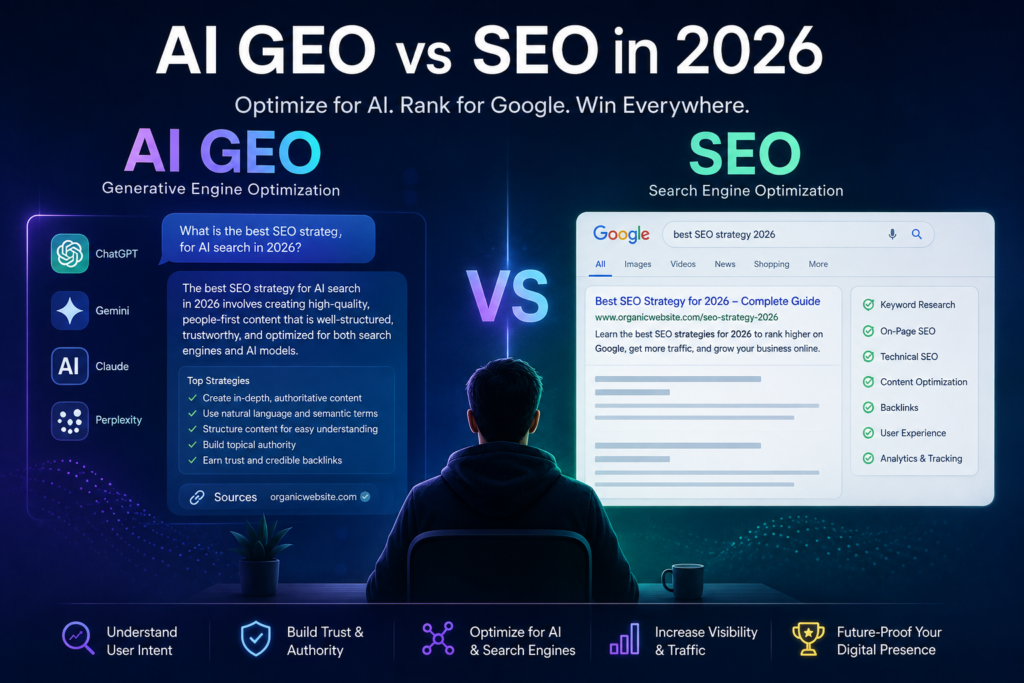

The digital search landscape is evolving faster than ever before. For more than two decades, businesses have focused on Search Engine Optimization (SEO) to improve their visibility on platforms like Google and Bing. Today, however, the way users discover information is changing. Instead of scrolling through pages of search results, people increasingly rely on AI-powered assistants such as ChatGPT, Google AI Mode, Gemini, Claude, and Perplexity to receive instant, conversational answers.
This transformation has introduced a new optimization strategy known as Generative Engine Optimization (GEO). Rather than replacing traditional SEO, GEO complements it by helping websites become trusted sources that artificial intelligence systems can understand, summarize, and reference. As AI-generated answers become a primary method of information discovery, businesses that embrace both SEO and GEO will gain a significant competitive advantage.
Understanding the Difference Between SEO and GEO
Traditional Search Engine Optimization focuses on improving a website’s visibility within search engine result pages (SERPs). The goal is to rank for valuable keywords, attract qualified organic traffic, and convert visitors into customers. SEO involves optimizing page speed, technical performance, content quality, backlinks, internal linking, structured data, mobile usability, and overall user experience.
Generative Engine Optimization, on the other hand, focuses on making content easily understandable for Large Language Models (LLMs) and AI-powered search experiences. Instead of optimizing solely for rankings, GEO aims to increase the likelihood that AI systems will cite, summarize, or recommend your content when users ask complex or conversational questions.
In simple terms, SEO helps users find your website, while GEO helps AI systems understand and trust it.
Rather than competing with each other, these two disciplines work together to maximize digital visibility. A website with strong technical SEO but poor content structure may struggle to appear in AI-generated responses. Similarly, a well-written article without proper technical optimization may never be discovered in the first place. The future belongs to websites that successfully combine both strategies.
Why Generative Engine Optimization Matters More Than Ever
Artificial intelligence has fundamentally changed user behavior. Instead of typing short keyword phrases such as “best SEO agency” or “AI marketing tools,” users now ask complete questions like:
- Which SEO strategy works best for AI search?
- How do I optimize my website for ChatGPT?
- What is the difference between SEO and GEO?
AI assistants analyze information from multiple trusted sources before generating a single comprehensive response. This means your content no longer competes only for the first position on Google—it competes to become one of the authoritative sources AI models rely on.
For businesses, this shift creates entirely new opportunities. Being referenced in AI-generated answers increases brand visibility, strengthens credibility, attracts highly qualified visitors, and positions your organization as an industry authority. As AI search adoption continues to accelerate, optimizing for AI discoverability is becoming just as important as optimizing for traditional search rankings.
The Core Principles of AI-Friendly Content
Content designed for AI should prioritize clarity, accuracy, and depth. Large Language Models interpret information differently from conventional search algorithms. They seek well-organized, factually reliable, semantically rich content that directly answers user intent.
Instead of beginning every article with lengthy introductions, modern content should answer the primary question early before expanding into detailed explanations. Short paragraphs, descriptive headings, comparison tables, bullet points, and logical content hierarchy all improve machine readability while enhancing the user experience.
Equally important is semantic optimization. Modern search algorithms no longer rely on exact-match keywords alone. They understand concepts, relationships, and context. Rather than repeating a single keyword unnaturally, effective content naturally incorporates related phrases such as AI Search Optimization, Answer Engine Optimization (AEO), Semantic SEO, Topical Authority, Entity SEO, Knowledge Graph Optimization, LLM Optimization, and Conversational Search. These related concepts help search engines and AI models understand the complete topic rather than isolated keywords.
Building Topical Authority Through Content Clusters
One of the strongest signals for both SEO and GEO is topical authority. Instead of publishing unrelated articles, successful websites organize content into interconnected topic clusters.
For example, a comprehensive pillar page on AI SEO can naturally connect to supporting articles covering Technical SEO, Semantic SEO, Schema Markup, Content Marketing, AI Overviews, Core Web Vitals, Search Intent Optimization, Internal Linking, Link Building, and Entity-Based SEO. These internal connections help search engines understand your expertise while allowing AI systems to recognize your website as a reliable knowledge source.
Thoughtful internal linking also improves crawl efficiency, distributes page authority, and encourages visitors to explore additional content, leading to stronger engagement and longer session durations.
EEAT: The Foundation of Trust in AI Search
Trust has become one of the most valuable ranking factors in modern search. Google’s Experience, Expertise, Authoritativeness, and Trustworthiness (EEAT) framework aligns closely with how AI systems evaluate information quality.
Publishing well-researched content, citing credible sources, showcasing genuine industry experience, maintaining updated information, and demonstrating subject matter expertise all contribute to higher trust signals. Websites that consistently provide accurate and transparent information are significantly more likely to be referenced by AI-generated search experiences.
Original insights, real-world examples, practical case studies, and firsthand expertise are increasingly valuable because AI systems seek information that goes beyond generic summaries.
Technical SEO Still Powers AI Discoverability
Although GEO focuses heavily on content quality, technical SEO remains essential. AI crawlers still depend on accessible website architecture to discover and interpret information efficiently.
Fast loading speeds, Core Web Vitals optimization, mobile responsiveness, HTTPS security, structured data, XML sitemaps, canonical URLs, optimized images, and clean site architecture continue to influence discoverability. A technically optimized website allows both traditional search engines and AI crawlers to access information quickly and accurately.
Structured data deserves special attention because it helps search engines identify products, services, organizations, FAQs, articles, reviews, and other important entities. The clearer your website communicates its information, the easier it becomes for AI systems to reference that content confidently.
Creating Content That AI Wants to Reference
The most successful AI-friendly articles share several common characteristics. They answer questions directly, explain concepts clearly, provide sufficient context, and remain easy to scan. Long walls of text are gradually being replaced by structured sections, descriptive subheadings, concise paragraphs, comparison tables, checklists, definitions, FAQs, and practical examples.
Evergreen resources continue to perform exceptionally well, especially when combined with regular updates that reflect emerging technologies and changing search behavior. Comprehensive guides, research-backed articles, implementation tutorials, industry case studies, and expert opinion pieces are particularly effective because they provide lasting value while demonstrating topical authority.
Trending AI SEO Keywords for 2026
To strengthen semantic relevance, businesses should naturally incorporate related keywords throughout their content rather than relying on repetitive keyword placement. High-value terms currently shaping AI search include Generative Engine Optimization, AI SEO, Answer Engine Optimization (AEO), AI Discoverability, AI Search Optimization, LLM Optimization, Google AI Mode, AI Overviews, Semantic SEO, Entity SEO, Knowledge Graph Optimization, Topical Authority, Vector Search, Retrieval-Augmented Generation (RAG), Zero-Click Search, Conversational Search, Content Clusters, Search Intent Optimization, AI Citation Optimization, and Structured Data SEO.
When these concepts are integrated naturally into informative, user-focused content, they improve both semantic understanding and topical relevance without sacrificing readability.
Looking Ahead: The Future of Search Is AI-Assisted
Search is no longer limited to ranking on a search engine results page. The next generation of digital visibility depends on becoming a trusted source that both people and artificial intelligence can rely upon.
Organizations that combine robust technical SEO with comprehensive, authoritative, AI-friendly content will be best positioned for long-term success. Rather than viewing GEO as a replacement for SEO, businesses should recognize it as the next evolution of search optimization—one that prioritizes trust, clarity, semantic understanding, and genuine expertise.
As AI continues to reshape how information is discovered, the websites that consistently publish accurate, well-structured, and genuinely helpful content will earn visibility across Google, AI-powered search experiences, and future conversational platforms. The objective is no longer simply to rank first; it is to become the source that search engines and AI assistants confidently recommend whenever users seek reliable answers.

Leave a Reply